So, for those of you not keeping track, I graduated from The George Washington University in May with a bachelors degree in History. Shortly after, I left Washington, D.C. and have been living at home in California for the last few months.
For those of you who are keeping track, you'll notice that I never completed my goal of visiting every Catholic church in Washington. It's not that I didn't want to, or didn't have any interest in the parishes that remained on my list, but I simply didn't have the time and energy left during my senior year. I was working, participating in student organizations, writing my thesis, passing my classes, and planning my post-grad life. Getting up on Sundays, trekking out to churches across the city and then writing about them just wasn't in the cards.
And though I didn't do what I set out to do, I wouldn't have traded this experience for the world. It started off one day when I was sitting in my dorm room freshman year, looking up Washington D.C.'s churches, when an idea popped into my head. "What if I visited every church in the District and then blogged about it?" And so it began. The powerful thing for me, an 18-year-old kid just coming out of high school, was that it was one of the first large-scale endeavors that I conceived and executed entirely on my own. Watching the process change from "What if..." to "Wow, I'm actually doing this!" was really powerful and has inspired just about everything I've done since.
I learned a lot about Catholicism and a lot about Washington. Before this project, I had never heard of a black Catholic parish. By the end, I had been to half a dozen and had written a research paper on the formation of black Catholic parishes in Washington in the 1920s. I saw a lot of neighborhoods I never would have seen and met a bunch of interesting people. And of course, I made some great friendships with the people I would go to church with: Dan, Loreto, Kate and plenty more.
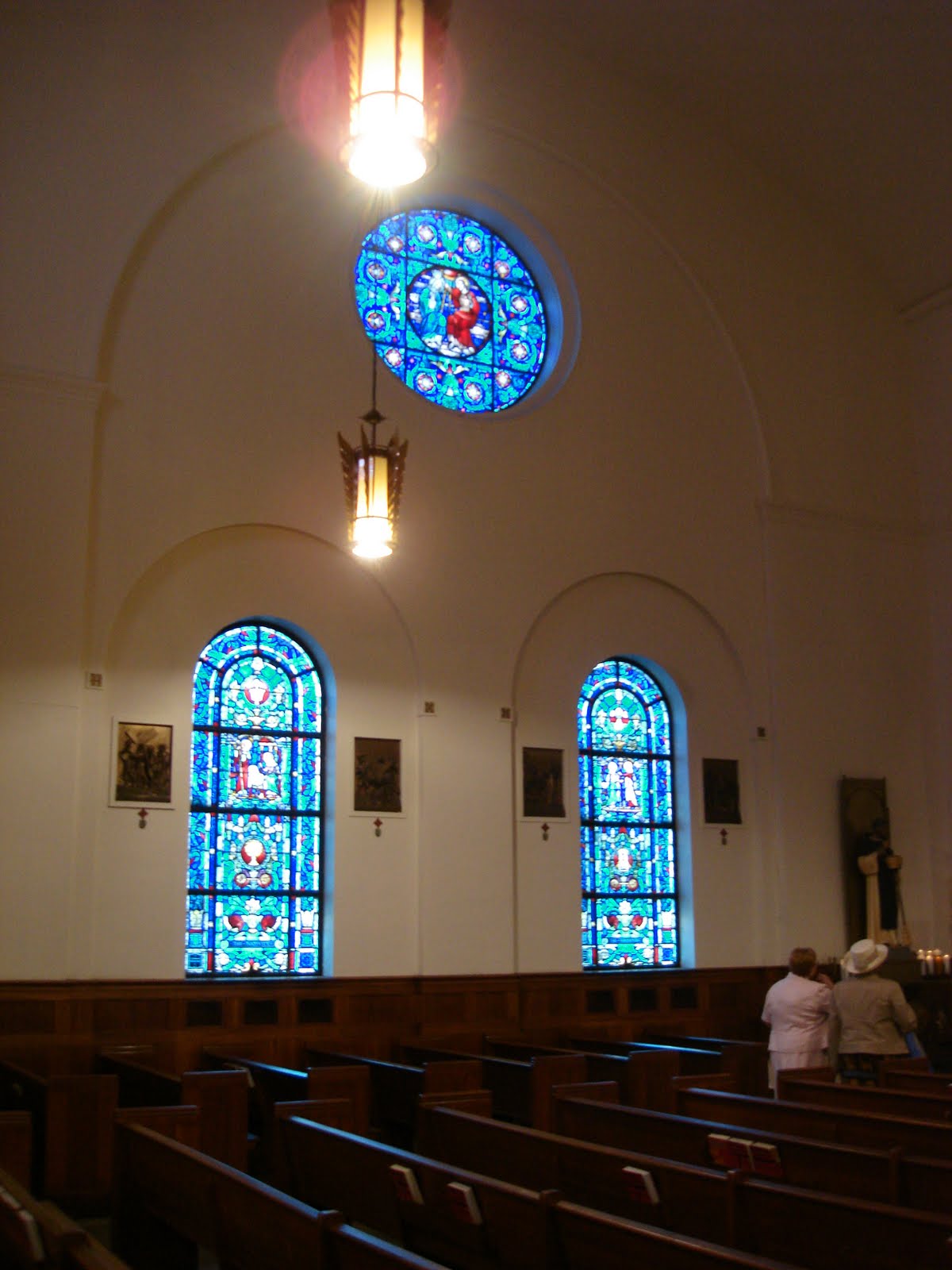
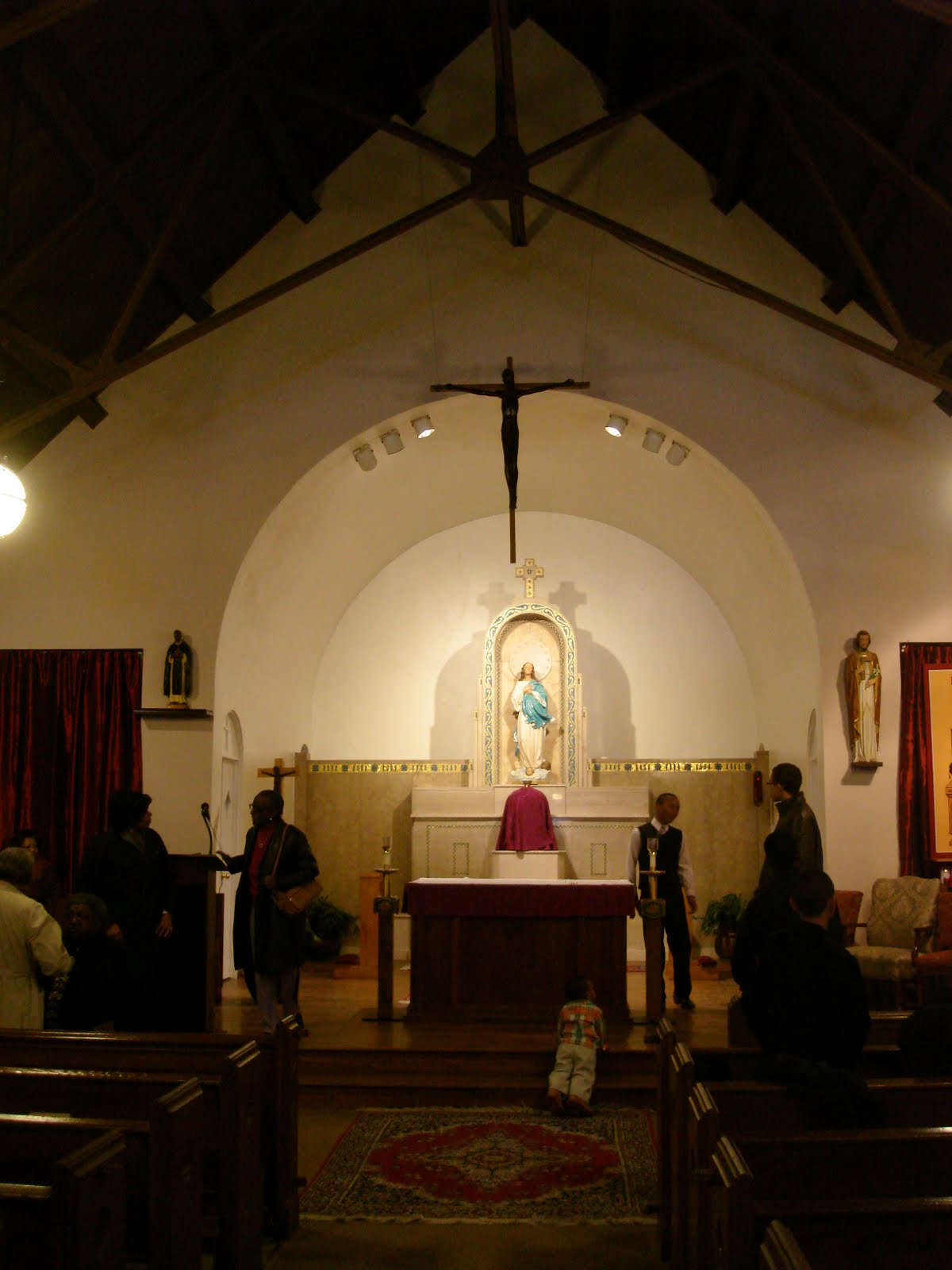
And so, when I returned to Washington earlier this month, I figured I should give Capitol Catholic its due - one last visit to one of my favorite parishes with one of my favorite churchgoing buddies, Dan. Luckily, Dan lives two blocks from St. Augustine's, one of the first parishes I wrote about and one that I've been back to at least one time since. It's the city's first black Catholic parish, and at 12:30 every Sunday, it holds an outstanding Mass backed by its excellent Gospel choir.
The choir was in fine form this morning, as was Father Pat, who gave a stirring sermon. Father Pat is one of the best homilists I've ever seen. His homilies are both complex, profound, light, and relatable. Whereas most homilists will try to return to one single message, Pat riffs between six or seven, and manages to tie them altogether into a coherent whole. This time he was full of great lines and comparisons, my favorite being his description of God's love for mankind as being similar to a Marvin Gaye song: "I want you, and I want you to want me too."
The most remarkable thing about the Mass, for me, wasn't the great sermon or the always-spot-on choir, but the people in attendance. Washington has always maintained some form of racial segregation in its Catholic parishes. Before and after the Civil War, African-Americans were forced to sit in the rear balconies of white parishes. St. Augustine's was part of a movement on the part of black Catholics to create their own parishes, a movement which would eventually result in a system of dual, overlapping parishes for whites and blacks in the city of Washington.
Which is why it was so interesting to me to see so many white faces in the crowd that day at St. Augustine. Washington is changing. You don't have to be a genius to see the effects that gentrification is having on the city. Neighborhoods are undergoing drastic re-inventions as largely young, white, middle-class people move into areas previously occupied by working-class minorities. St. Augustine's neighborhood, the traditionally African-American U St., is no exception. And so, in the "Mother Church of Black Catholics," there's a growing population of Caucasians. And it's beautiful.
Whether the biracial worship that I saw that Sunday will continue for years into the future is hard to say. But after going to parishes throughout the city which were mostly ethnically homogenous, it was wonderful to see people crossing the line and worshipping with folks with a Catholic tradition other than their own. And maybe in a society where race continues to divide people, perhaps small pockets of shared worship can give way to a recognition of common humanity. Whether it's a sign of progress or not, it was very refreshing to see.
And so, with that, it's time to retire the Capitol Catholic blog. It was a fun ride, but all things come to an end. Thanks for reading, and God bless.
-Michael
I am a senior at The George Washington University. I am embarking on a project to attend Mass at every Catholic Church in the District of Columbia.
03 October 2013
14 October 2012
Our Lady of Perpetual Help Church
After several busy weekends, I finally got back to church this weekend, attending Mass at Our Lady of Perpetual Help in the Anacostia neighborhood of Southeast Washington. It's one of the churches that I wrote about in my research paper last year on Washington's black Catholic churches, and was founded in 1921 after black members of St. Teresa of Avila parish decided to form their own church.
I had to drag my lazy, out of shape legs up Morris Rd. to get to OLPH, which is located on a big hill with a pretty nice view of the city. The church building, constructed in the 70s, had a very unusual diamond shape. I liked it though, since it allowed the parishioners to sort of sit surrounding the altar as opposed to just having long vertical rows.
The parish serves an interesting contrast to St. Teresa of Avila parish, which is only a few blocks down the road. I've written before about STA (here) and their spirited, emotionally charged service. Our Lady of Perpetual Help had a much more conservative feel; although incorporating the Gospel choir and many of the conventions of traditional African-American worship, there wasn't so much raw emotion and intensity. That isn't to say it wasn't a nice service: they had a twenty person Gospel choir which sounded great and a very talented, multi-tasking piano player. At one point I saw him simultaneously playing the piano, giving hand signals to the choir, standing to see what the priest was doing, and flipping his sheet music at the same time. They closed with a beautiful rendition of "I Have Decided to Make Jesus My Choice."
I had to drag my lazy, out of shape legs up Morris Rd. to get to OLPH, which is located on a big hill with a pretty nice view of the city. The church building, constructed in the 70s, had a very unusual diamond shape. I liked it though, since it allowed the parishioners to sort of sit surrounding the altar as opposed to just having long vertical rows.
The parish serves an interesting contrast to St. Teresa of Avila parish, which is only a few blocks down the road. I've written before about STA (here) and their spirited, emotionally charged service. Our Lady of Perpetual Help had a much more conservative feel; although incorporating the Gospel choir and many of the conventions of traditional African-American worship, there wasn't so much raw emotion and intensity. That isn't to say it wasn't a nice service: they had a twenty person Gospel choir which sounded great and a very talented, multi-tasking piano player. At one point I saw him simultaneously playing the piano, giving hand signals to the choir, standing to see what the priest was doing, and flipping his sheet music at the same time. They closed with a beautiful rendition of "I Have Decided to Make Jesus My Choice."
07 August 2012
Shrine of the Most Blessed Sacrament
This Sunday, I went to another church on the border of Washington, D.C. and Maryland, but this time on the Western edge, near Friendship Heights. The neighborhood was really nice and mellow, with a lot of churches along the way.
I could have sworn this Mass started at 11:00, and I arrived, late, from the Metro, at 11:10. However, it turns out I was wrong and the Mass had started at 10:30. I caught the very end of the Mass while standing at the back of the church. I was pretty embarassed, as I stood in the back and watched like a loser. The parish seemed like it was booming, with a Mass full of young families and children. The church building utilized a lot of stone, and looked like it had been constructed fairly recently. Outside was a giant fir tree that I can only imagine is utilized as a Christmas tree.
22 July 2012
Church of the Incarnation
So, as I may or may not have mentioned before, I'm working now towards the end of the Capitol Catholic project. Thanks to my laziness in previous semesters, most of the churches left on my list are pretty hard to get to, either far from Metro stations or in distant parts of the city. Today's church, Incarnation, was no exception.
Incarnation was formed in 1914, one of the original black parishes in the district. It was formed for the rural community of Deanwood and its new church, built in 1959, rests on Eastern Avenue in Northeast DC. Eastern Avenue is the dividing line between the District of Columbia and Maryland, and Incarnation is one of three parishes that lie directly on the border between DC and Maryland. As I walked to church on Eastern, I saw DC license plates on one side of the street and Maryland licenses on the other.
It took me a while to get out to Incarnation, and I ended up showing up to the Mass about half an hour late. I was treated to a nice, mellow Mass, with a few Gospel hymns thrown in by a small ensemble. My favorite was "Oh Lord, I Want You to Help Me," done by the bassist and the pianist.
Incarnation was formed in 1914, one of the original black parishes in the district. It was formed for the rural community of Deanwood and its new church, built in 1959, rests on Eastern Avenue in Northeast DC. Eastern Avenue is the dividing line between the District of Columbia and Maryland, and Incarnation is one of three parishes that lie directly on the border between DC and Maryland. As I walked to church on Eastern, I saw DC license plates on one side of the street and Maryland licenses on the other.
It took me a while to get out to Incarnation, and I ended up showing up to the Mass about half an hour late. I was treated to a nice, mellow Mass, with a few Gospel hymns thrown in by a small ensemble. My favorite was "Oh Lord, I Want You to Help Me," done by the bassist and the pianist.
01 July 2012
Nuestra Senora Reina de las Americas (Our Lady Queen of the Americas)
At long last, I'm back in Washington after a semester in Ecuador and a short visit to my family and friends in California. With my senior year approaching, I decided to re-focus myself and finish the Capitol Catholic project, which I have dedicated so much time and effort to over the last couple years. I made a list and there's 13 churches left for me to visit. I'm excited to get working and am hoping to finish the project by the end of the fall semester.
My visit today was to Our Lady, Queen of the Americas Parish. They're located in a neighborhood northwest of DuPont circle, close to Sheridan Circle and Embassy Row. They do most of their Masses in Spanish, which was fine by me, since I've been looking for opportunities to practice the Spanish I've learned in Ecuador.
The parish doesn't have a typical church building, they have a three floor brick building which also doubles as a parish hall and a language school. The worship space was on the third floor, and was brightly colored. The walls were mostly a turquoise-y green and complemented with a salmon-y pink. There was also some crazy-bright colored stained glass on the right side of the church. I didn't take notes during the sermon today, but the Gospel reading was about Jesus curing a dying woman, so the priest offered a blessing of the sick.
My visit today was to Our Lady, Queen of the Americas Parish. They're located in a neighborhood northwest of DuPont circle, close to Sheridan Circle and Embassy Row. They do most of their Masses in Spanish, which was fine by me, since I've been looking for opportunities to practice the Spanish I've learned in Ecuador.
The parish doesn't have a typical church building, they have a three floor brick building which also doubles as a parish hall and a language school. The worship space was on the third floor, and was brightly colored. The walls were mostly a turquoise-y green and complemented with a salmon-y pink. There was also some crazy-bright colored stained glass on the right side of the church. I didn't take notes during the sermon today, but the Gospel reading was about Jesus curing a dying woman, so the priest offered a blessing of the sick.
04 January 2012
Ecuador-Bound
I got very busy this past semester and didn't get to visit as many churches as I would have liked to. I'm looking forward to finishing the project during the 2012-2013 school year, since I will not be in Washington for the Spring 2012 semester. I'll be studying Spanish language and Ecuadorian culture in Quito, Ecuador from January until May.
I'll be keeping a blog while I'm down there. Follow me at:
God Bless, Friends.
Holy Comforter/ St. Cyprian Church
I finally visited another church in December, after a long, hard semester which kept me too busy to work on Capitol Catholic. I took my friend Dan to Holy Comforter/ St. Cyprian Church in the Capitol Hill area. I knew a bunch about the history of the parish because I studied it as part of a paper I wrote on black Catholic parishes in Washington, D.C. From my paper:
The parish formed as a result of increasing black migration into Washington, providing a large enough base to support another parish. Between 1880 and 1890, Washington’s black population increased from 48, 377 to 75,572, or 40.1% of the city’s population. Many settled in the Capitol Hill area, east of the Capitol, where the African-American Catholics attended St. Peter’s parish. They were forced to sit in the rear of the church and were offered few services, since the parish priests considered them technically part of the colored parish, St. Augustine’s. This policy engendered complaints as early as 1878, when a letter was sent from Catholics in east Washington to Archbishop of Baltimore James Gibbons, bemoaning the “deaths of a number of colored Catholics without the last sacraments because the other reverend fathers, considering them as parishioners of the distant St. Augustine’s, would not attend to their spiritual needs.”
Eventually, the voices of these Catholics were heard, and James Cardinal Gibbons sent a Maryland priest, Father James R. Matthews, to St. Peter’s, to work with the black Catholics. He initially held Masses in the former parish hall, and the new parish was organized in 1893. While credit is due to the initiative of the St. Cyprian’s parishioners and the hard work of Father Matthews, it is evident that the most important factor in forming St. Cyprian’s was the increase in black population in Washington and the Capitol Hill area in particular. The St. Joseph’s Advocate noted at the St. Cyprian’s cornerstone-laying that there was a “need long felt of this second church in a section of Washington abounding with colored people having a large percentage of Catholic families for generations accommodated at St. Peter’s.”
St. Cyprian, facing decaying facilities and a smaller parish, merged with nearby Holy Comforter parish, formerly a majority white parish, in the 1960's. Today, the Mass at the merged parish features a large Gospel choir and a very passionate service. The priest gave a sermon which discussed how we develop in our faith, and told stories about working as the only African-American in a small farming town in California. The Mass closed up with a performance of one my favorite Gospel pieces, "I Opened My Mouth To The Lord," a fiery piece which requires that three parts of the choir sing different pieces of the hymn at the same time. It was great, and a great way to end the semester.
03 January 2012
St. Francis Xavier Church
These are some pictures from my visit to St. Francis Xavier Church in Southeast D.C. in September. I have delayed doing this so long that I have lost my notes and honestly couldn't tell you much about the service. There was a small choir and they incorporated a few Gospel hymns into the Mass, but it was much more low-key than churches like St. Teresa of Avila. I also brought my friend Hunter, who enjoyed the Mass.
05 September 2011
Our Lady of Victory Church
Hey friends! It's back to D.C. for another semester of church visits. Yesterday I went to Our Lady of Victory Parish in Northwest D.C. It's in a cute neighborhood east of Georgetown which is also home to George Washington University's Mount Vernon campus. Instead of taking the shuttle to Mount Vernon, I walked to OLV along the C&O Canal path.
Our Lady of Victory is a relatively small church perched on top of a grassy hill. The brick building had a pentagonal facade and had relatively bare walls on the inside. Colorwise, the church was dominated by blue, white and brown, with blue carpet, a blue velvet apse, and brown support beams. There was a very cool looking medieval-style painting near the front as well.
Music was provided by an organ and a choir of about half a dozen people. It was refreshing to hear their traditional hymns after slacking off on church attendance this summer. In his homily, the priest discussed the beginnings of the Church, and said that it formed a "body" of which the Pope was the "head." He compared the body of the Church to a symphony, which despite being made up of diverse "instruments" and "voices," is able to make beautiful music because they read from Christ's score.
View DC Churches I've Been To So Far in a larger map
Our Lady of Victory is a relatively small church perched on top of a grassy hill. The brick building had a pentagonal facade and had relatively bare walls on the inside. Colorwise, the church was dominated by blue, white and brown, with blue carpet, a blue velvet apse, and brown support beams. There was a very cool looking medieval-style painting near the front as well.
Music was provided by an organ and a choir of about half a dozen people. It was refreshing to hear their traditional hymns after slacking off on church attendance this summer. In his homily, the priest discussed the beginnings of the Church, and said that it formed a "body" of which the Pope was the "head." He compared the body of the Church to a symphony, which despite being made up of diverse "instruments" and "voices," is able to make beautiful music because they read from Christ's score.
View DC Churches I've Been To So Far in a larger map
02 August 2011
A Couple Links
Here's a new blog project I'm working on before I go back to visiting D.C.'s churches in September. I'm doing 20 different hikes every day from August 1-20.
20hikes20days.wordpress.com
Do you know about the Power of Love Foundation?
Power of Love is an innovative non-profit that works with communities in Africa struggling with the AIDS epidemic. In order to create healthy, self-reliant communities, Power of Love (1) Trains women to care for their HIV-infected children and orphans, (2) Provides women with micro-loans and business training to generate income, and (3) Provides food, medicines, and a package of life-saving healthcare services to the children in their care.

My good friend Annu wrote some great blog entries about her experiences visiting the Power of Love's care center in Lusaka, Zambia earlier this summer:
http://annutozambia.wordpress.com/
Click below to read more about the Power of Love, sign up for the e-newsletter, and donate. POL does important work that Catholics and non-Catholics should be eager to support. Thanks so much!
20hikes20days.wordpress.com
Do you know about the Power of Love Foundation?
Power of Love is an innovative non-profit that works with communities in Africa struggling with the AIDS epidemic. In order to create healthy, self-reliant communities, Power of Love (1) Trains women to care for their HIV-infected children and orphans, (2) Provides women with micro-loans and business training to generate income, and (3) Provides food, medicines, and a package of life-saving healthcare services to the children in their care.
My good friend Annu wrote some great blog entries about her experiences visiting the Power of Love's care center in Lusaka, Zambia earlier this summer:
http://annutozambia.wordpress.com/
Click below to read more about the Power of Love, sign up for the e-newsletter, and donate. POL does important work that Catholics and non-Catholics should be eager to support. Thanks so much!
![]() |
15 July 2011
St. Brigid Catholic Church (Los Angeles, CA)
A few weeks ago, I took my mom to St. Brigid’s Catholic Church in Los Angeles. After two years of stories about D.C.’s black Catholic churches, I figured we should try to visit an African-American parish in L.A. St. Brigid is located southeast of downtown Los Angeles and it is famous for its Gospel choir.
We came for the 10:30 AM Mass, which didn’t end up starting until around 10:50. The procession was led by three young men beating on drums with their hands in African-style rhythms. The priest, Father Frank, began the Mass by pouring water into a small plant and calling on the parish to remember their ancestors. I asked him about this later, and he said that it derives from West African tradition, which begins religious worship by calling on ancestors. Watering the plant is a symbol of life.
The church had some very pretty architectural elements, though it didn’t appear to have a unifying theme. There seemed to be a lot of African-inspired design elements, as well as a lot of dark green features. I did notice that while the left side of the church had a very cool looking stained glass window, the corresponding window on the right had nothing. I actually like it when churches are left partially unfinished (even unintentionally) because it’s a great symbol for mankind’s inability to achieve perfection.
The choir consisted of around a dozen members, and they did a nice job. On this particular Sunday, Beau Williams, a Gospel singer, came by to sing a few songs and sell some CD’s. He had a great voice, but I still found his rather transparent attempt to promote himself was a little bit inappropriate for Mass. After getting some applause after his first song, Beau tried to get permission from Father Frank to sing a second tune. “Later,” the priest said.
In his homily, Father Frank said that the Body of Christ is present not only in the Eucharist, but also in the church members who come together to worship as one body in Christ. Altogether it was a wonderful Mass. At the end of the Mass, visitors were asked to stand. I introduced myself, and told everyone that I had brought my mother with me. After church, a few shocked parishioners told us that they thought she was my sister. Pleased, though not surprised, my mother said: “They sure know what to say to make you want to come back.”
Pictures:
28 June 2011
Pittsburgh Catholic
18 May 2011
St. Martin of Tours Church
For my final church visit of the year, I asked my good friend John, who’s gone with me to a bunch of different churches, to pick which church he’d like to go to. I also wanted him to do it because he’s not coming back to GW next year as a FOCUS missionary, since joining the seminary to study to become a priest next year. At any rate, he picked the 9 AM Mass at St. Martin of Tours in Northeast Washington. After trying to figure out how long it would take to take the Metro there, a trip involving several transfers and a considerable walk to the church, I suggested that we just walk the entire way from Foggy Bottom. It was about a forty minute walk up Rhode Island Avenue, and John, Loreto and I got to enjoy a beautiful day in Washington.
St. Martin of Tours is in an interesting location, situated on hill right next to a bridge going over North Capitol Street. It was hard to distinguish a single architectural style on the building, it seemed to embrace neo-classical Greek and Roman architecture. The interior of the church had mostly plain white walls, with blue stained glass windows. At the front of the church were two banners, one depicting human figures dancing, and another showing a caterpillar becoming a butterfly. At the rear of the church, below the choir loft, there were two quilts hung with African-influenced patterns. The area behind the altar had a large wooden frame and a golden cross; it had a very modern feel.
There was one cantor singing accompanied by the powerful pipe organ. The Mass was interesting because not all of the pews had kneelers, so rather than kneeling, the parish stood up. I asked Deacon Robert about this after Mass, and he said that the standing was also something the parish chose to do regardless of the missing kneelers. Father Michael gave the homily, and discussed the appearance of Jesus to the men on the road to Emmaeus. He reminded us that these fellows were leaving Jerusalem disappointed before Jesus appeared to them. While they may have given up on Christ, but Christ did not give up on them. Father said that our mothers often do the same thing in our lives, and then called the church’s mothers up to the altar for a Mother’s Day blessing. When he did, a long line of mothers formed that went all the way to the back of the church.
John, Loreto, and I went downstairs after Mass for a fundraiser for the parish youth group’s production of The Wiz. We had a nice time talking with Deacon Robert and our new friend Irene, a nursing professor at Georgetown University who supervised a service-learning project at St. Martin of Tours. It was a great way to end the semester.
Links:
St. Martin of Tours Website (The noisiest church website I've ever been on)
Pictures:
Churches I've Been To So Far:
View DC Churches I've Been To So Far in a larger map
St. Mary Mother of God Church (Tridentine Latin Mass)
A few weeks ago, my friend and fellow Knight of Columbus Peter suggested a trip to St. Mary, Mother of God Church in Chinatown to see their Tridentine Latin Mass. I jumped at the chance to go, as did several other friends from the Knights of Columbus and the Newman Center: Christina, Francisco, and (another) Michael. I had been to St. Mary Mother of God before to see their 11:30 AM Mass in Cantonese (Chinese), so I already knew what it was like to sit in that church for an hour without having any idea what was going on.
The Tridentine Latin Mass is the Mass that was performed in the Catholic Church before the 1962 Vatican Conference, which produced a new order of the Mass (known as “Novus Ordo,” or “New Order”) and allowed Masses to be given in vernacular languages. I have previously seen a “Novus Ordo” Latin Mass, a Mass in which the post-Vatican II Mass was given in Latin, but it is much rarer to see the pre-Vatican II Tridentine Latin Mass, which can only be performed with the permission of a local Archbishop.
St. Mary Mother of God was the same neo-Gothic church that I had seen before, except for a worn down shrine section of the church, which had since been improved with a navy-blue background and a large metal image of the Virgin Mary. The congregation was very conservatively dressed, with men generally wearing suits, and many women wearing veils. There were a lot of elderly folks at Mass, but a few families as well, like the one with five or six children that sat in front of us. Nearly everyone at the Mass was Caucasian.
The Mass itself was a very interesting affair. For much of the celebration, the priest, had his back to the congregation. He would chant a verse of a prayer or reading, and a response would come either from the congregation or the fantastic choir sitting in the loft at the rear of the church. The choir was fantastic, and their wonderful songs and chants filled the space with a very uplifting ambience. I was pretty confused as to what was going on throughout the Mass because, of course, I failed to grab one of the Latin Missal booklets located at the front of the church. I didn’t realize that nearly every section of the Mass was sung either by the choir or the priest, including the first two readings. I thought I had missed the entire Liturgy of the Word until the priest read the Gospel (in English).
The priest, who wore some sort of hat during the Mass (it looked like a beret) and spoke with a British accent, said in his homily that if we do not actively engage our faith, we become passive spectators to a grand spectacle, like the British Royal Wedding. He said that to avoid doubt, like that of the apostle Thomas in the Gospel reading, we need to work our faith out like a muscle. Part of exercising that faith, he said, was receiving Holy Communion, which preserves Christ’s resurrection over time. Later in the Mass, the congregation received Holy Communion in a manner that I’ve never seen before; we knelt before a small wall in front of the altar, and the priests and Eucharistic ministers distributed the host to our tongues as we knelt. It was a very interesting end to this very traditional Mass. Personally, I didn’t really feel connected to this Mass and some of my friends felt the same way. I think it is great that this tradition is kept alive, but I can also see why the Church moved away from the Tridentine Latin Mass and began to allow Masses in the vernacular.
Links:
Photos:
(This shrine has been recently refurbished)
24 April 2011
St. Augustine Church- Easter Mass
For Easter this year, I decided to go one of my favorite churches in Washington, St. Augustine Church on U St. (Click here to see my original post on St. Augustine from December 2009).They're famous for their fantastic gospel choir and energetic pastor, Father Pat. I invited my friend Mike from work to come with me, he's a student from Ohio spending the semester interning in Washington, D.C. We thoroughly enjoyed the spectacular music and the wonderful atmosphere. Happy Easter everyone!
Assumption Catholic Church
On April 3, my good friend Dan and I visited Assumption Catholic Church, in the Congress Heights neighborhood of Southeast Washington. It’s been a few weeks since that visit, so I’m having a hard time remembering the finer points of the Mass, but I can affirmatively say that Dan and I absolutely loved this church. According to a parish history given to me after Mass, the parish was formed in 1916, and their current church building was finished in 1933. The church building reminded me a lot of the chapel at St. Anselm’s Abbey because of its pentagonal face, brick walls, and slanted wooden roof.
There was a small choir providing the music, made up of six or seven ladies and a man accompanying them on the piano. They seemed to incorporate a gospel style of music, but their hymns were less fiery and energetic than those of, for example, St. Teresa of Avila parish or St. Augustine parish. I enjoyed this calmer form of worship, which seemed appropriate for this small, intimate church.
Undoubtedly, my favorite part of the service was Father Montgomery’s homily. He was incredibly entertaining, charismatic, and delivered some clear, important messages from the day’s Gospel readings. He started off by questioning the validity of televangelists like Oral Roberts and Benny Hinn. If these people really have such a great connection with God, he asked, why do they continually face health and marital problems? He then jokingly suggested that he could bring in as many donations as these televangelists by holding a “healing,” where he would slap his parishioners around and then send them running into the street yelling, “I’m healed!!” He then discussed the day’s Gospel, in which Jesus healed a blind man. In Jesus’ time, many saw blindness as a punishment from God for sinning, but Jesus refused to speculate on the man’s past and relieved him of his blindness anyway. This was evidence, said Father Montgomery, that our God is not a vengeful God, but a God of “compassion and mercy.”
Links:
Pictures:
Churches I've Been To So Far (29!)
View DC Churches I've Been To So Far in a larger map
Subscribe to:
Posts (Atom)